January 26th, 2026 - Press release

Deaths among patients with acute myocardial infarction before reaching hospital were reduced, during the response by the Medical Emergency System of Catalonia (SEM), by 20% during this period, compared with what would have been expected in the period prior to the implementation of this initiative.
Overall, 28-day mortality after suffering a heart attack decreased significantly, falling from 27% of cases to 19%.
These findings are highlighted in a study by researchers from the Hospital del Mar Research Institute, in collaboration with Hospital de Sant Pau and Hospital Clínic de Barcelona, which analysed data from 100,000 people who suffered a heart attack in Catalonia between 2008 and 2019.
The implementation of the IAN Code in Catalonia-the urgent care network for acute myocardial infarction-has proven to be a clear success. During the first seven years after its launch, mortality before hospital arrival fell by 20% compared with the expected trend based on data from the period prior to its implementation. This represents nearly 2,600 fewer deaths than expected, according to a study by researchers from the Hospital del Mar Research Institute, in collaboration with Hospital de Sant Pau, Hospital Clínic de Barcelona, the Department of Health of Catalonia, and the CIBER of Cardiovascular Diseases (CIBERCV) and CIBER of Epidemiology and Public Health (CIBERESP).The study has been published in the European Journal of Public Health.
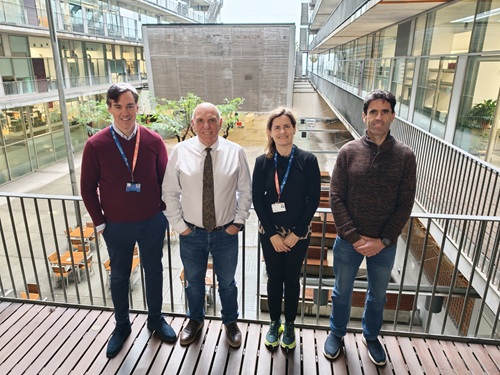
Left to right, Miguel Cainzos-Achirica, Jaume Marrugat, Helena Tizon, Isaac Subirana
The study analyses nearly 100,000 heart attack cases in people aged 35 to 84 in Catalonia between 2008 and 2019, combining data from the IAM Code registry, hospital discharge records, and the mortality registry. The analysis was carried out using data from the PADRIS (Programme for Data Analytics for Research and Innovation in Health) of the Agency for Health Quality and Assessment of Catalonia (AQuAS). The aim of the study was to assess whether the implementation of this emergency care network-launched in late 2010 and fully deployed by 2012-had contributed to reducing heart attack fatality rates across the population as a whole. Its operation is based on the early detection and rapid activation of the code, enabling the Catalan Medical Emergency System of Catalonia (SEM), Primary Care centers and hospitals to coordinate care immediately, decisively reducing response times in the event of a heart attack. In many cases, calling 112 is the first step in activating this care pathway, allowing for a rapid diagnosis and early initiation of treatment.In addition, reference hospitals are always on standby in Catalonia to manage these cases.
The results show that overall fatality 28 days after a heart attack has decreased significantly since 2011. This improvement "is explained almost entirely by a sustained reduction in pre-hospital mortality, that is, sudden deaths occurring outside hospital settings, which often take place before specialised medical care can be provided," explains Dr. Jaume Marrugat, researcher at the Hospital del Mar Research Institute, coordinator of the REGICOR (Girona Heart Registry) group and researcher at CIBER of Cardiovascular Diseases (CIBERCV).
Overall, mortality before hospital arrival fell from 22% in 2008 to 15% in 2019, while the number of deaths occurring in hospital declined more modestly, from 9% to 6%. The authors attribute this pattern to the fact that the benefits of current in-hospital treatments have nearly reached their ceiling, that cardiac rehabilitation has not yet been widely implemented, and that, as a result of the success of the IAM Code, patients with greater clinical severity are now being admitted to hospital. In summary, over the period analysed, overall mortality decreased from 27% to 19%. In fact, with a similar number of cases, 1,200 deaths from myocardial infarction were recorded before hospital admission in 2019, compared with nearly 2,000 in 2008.
The researchers emphasise that, although the study is observational and therefore does not allow a direct causal relationship to be established, no other structural changes of a magnitude comparable to the IAM Code were identified in the Catalan healthcare system during the same period. This strengthens the hypothesis that the urgent care network has played a key role in reducing heart attack-related deaths at a population level. According to the analysis, mortality before hospital arrival declined in parallel with the implementation of the programme, suggesting that an increasing number of people suffering from a severe heart attack or an associated cardiac arrest are now reaching hospital alive thanks to early identification, the care provided by the SEM, and rapid access to coronary reperfusion, made possible through the alert issued by the SEM's Health Coordination Centre (CECOS) to the destination hospital.
The study also describes relevant changes in the profile of patients with myocardial infarction during the period analysed. Mean age has decreased slightly, while the prevalence of risk factors such as diabetes, hypertension, and previous cardiovascular disease has increased. This finding reinforces the need to continue strengthening cardiovascular prevention policies, particularly among younger age groups.Sex-based analyses show that overall trends are similar in men and women, although differences persist in incidence, which is approximately three times higher in men, as well as in some indicators of in-hospital mortality-an issue that warrants further research and targeted strategies.
The study concludes that "strengthening and consolidating myocardial infarction care networks, as well as improving the response carried out by the SEM, should remain a public health priority," notes Dr. Helena Tizón-Marcos, researcher with the Cardiovascular Diseases Research Group at the Hospital del Mar Research Institute, member of the REGICOR group within CIBERCV, and attending cardiologist at Hospital del Mar. She adds that "the reduction in mortality before hospital arrival demonstrates that the organisation of SEM and the speed of care can save lives even before hospital treatment begins." Out-of-hospital cardiorespiratory arrests, which frequently occur in the context of acute myocardial infarction, cause 2,700 deaths every year in Catalonia. In 2025, the SEM attended nearly 3,000 incidents in which the IAM Code was activated.
Helena Tizón-Marcos; Anna Camps-Vilaró; Irene Roman-Dégano; Isaac Subirana; Miguel Cainzos-Achirica; Teresa Puig; Josepa Mauri; Rosa Maria Lidon; Elena Arbelo; Jaume Marrugat. Declining 28-day population myocardial infarction case-fatality trends in Catalonia, Spain: an analysis of the possible contribution of emergency management network. European Journal of Public Health 2026, in press. DOI: 10.1093/eurpub/ckaf203
Parc Salut Mar
Passeig Marítim 25-29 Barcelona 08003
See location on Google maps
Phone: 93 248 30 00 · Fax: 93 248 32 54
Information request


© 2006 - 2026 Hospital del Mar · Legal notice and Privacy Police | Cookie Policy | Accessibility