December 11, 2025 - Press notes

The research team led by the Institut de Recerca Joan de Déu (IRSJD) and the Hospital del Mar Research Institute has, for the first time, demonstrated the efficacy of a drug in animal models developed from samples of patients from the Sant Joan de Déu Hospital.
The study identifies the PRKG1 gene as a key element in the biology of rhabdomyosarcoma and as a potential biomarker to predict treatment response.
The determination of Cristina's parents-a girl who passed away from rhabdomyosarcoma in 2015-has been crucial in making this study possible. Their commitment enabled the raising of more than €600,000 to promote research into new treatments for this type of pediatric tumor.
Ten years ago, Cristina's family-a girl who passed away from rhabdomyosarcoma-decided to transform their grief into a fight for life. At that time, there were no researchers at Sant Joan de Déu focused on finding a treatment capable of halting this type of pediatric cancer. Driven by hope, her parents launched a fundraising campaign that raised €600,000, also supported by the Leo Messi Foundation, which contributed €200,000. Their first goal was to fund a young pharmacologist, Estela Prada, with a very clear mission: to find an effective therapeutic approach against rhabdomyosarcoma. Ten years later, Dr. Estela Prada-recognized in 2024 with the prestigious Odile Schweisguth Award from the Société Internationale d'Oncologie Pédiatrique (SIOP) for the best early-career pediatric oncology researcher-has taken a decisive step toward that goal. Her work has allowed, for the first time, the demonstration of the efficacy of a drug in animal and preclinical models of this childhood tumor.
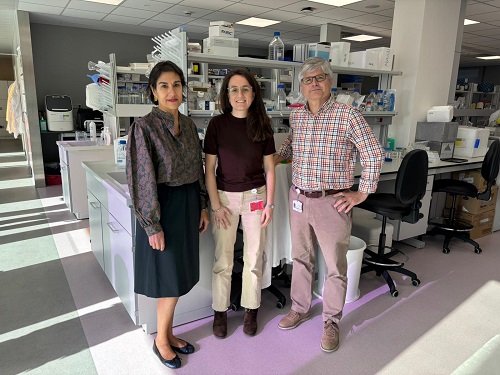
Left to right, Inmaculada Hernández Muñoz, Estela Prada, Jaume Mora
The study, "PRKG1 hinders myogenic differentiation and predicts response to AKT inhibitor Ipatasertib in Rhabdomyosarcoma", published in Nature Communications, was co-led by the Institut de Recerca Sant Joan de Déu (IRSJD) and the Hospital del Mar Research Institute (HMRIB), in collaboration with IRB Barcelona and the biotech company Nostrum Biodiscovery.
Rhabdomyosarcoma is a type of malignant tumor that develops from skeletal muscle cells and is the most common sarcoma in pediatric patients. Although it can appear anywhere in the body, it is often located in the face, neck, pelvis, or limbs. In pediatric populations, rhabdomyosarcoma can severely affect the function of organs and tissues near the tumor, cause pain, inflammation, or movement difficulties, and requires intensive treatment.
Despite significant advances in understanding the molecular biology of rhabdomyosarcoma (RMS), several therapeutic uncertainties remain that hinder improved prognosis, especially in high-risk or relapsed patients, who still represent 25-30% of cases despite current treatments, including chemotherapy, surgery, and radiotherapy.
One of the main challenges is that no common molecular mechanisms have yet been identified that would allow the development of effective targeted therapies for all RMS subtypes. The tumor cells are muscle precursors that remain blocked in their maturation process, and it is still not fully understood what maintains this block or how it can be safely reversed.
Moreover, as often occurs in pediatric oncology, many available targeted drugs were initially developed for adults and have not been sufficiently evaluated in children, both due to biological differences and toxicity profiles, which complicates their clinical translation.
"Our goal has always been to translate laboratory advances into real patient benefit. Demonstrating the efficacy of this drug in models developed from samples of our rhabdomyosarcoma patients gives us great hope to continue advancing toward more specific and less aggressive treatments," explains Dr. Estela Prada, researcher in the Sarcomas and Neuroblastoma group at IRSJD and first author of the study.
The study also concludes that the PRKG1 gene plays an essential role in blocking a key protein in rhabdomyosarcoma biology and may act as a biomarker to predict response to the drug, an AKT inhibitor currently being evaluated in clinical trials for different types of cancer.
The work combines cellular and animal models of rhabdomyosarcoma and demonstrates that tumors with higher levels of PRKG1 respond best to the treatment. This finding could allow the selection of pediatric patients who could benefit most from this drug and opens the door to new, more personalized therapeutic approaches.
"This is a step forward in understanding this type of pediatric cancer and in translating knowledge from the lab to the patient. We now know that PRKG1 is not only a key player in tumor biology but also a target that can help guide therapeutic decisions in the future," highlights Dr. Jaume Mora, Scientific Director of the Pediatric Cancer Center Barcelona at HSJD, head of the Sarcomas and Neuroblastoma Research Group at IRSJD, and senior co-author of the article. He recently received the IV Beca FERO Dr. Baselga, endowed with €300,000, to continue advancing in the identification of a treatment against rhabdomyosarcoma.
In this regard, Dr. Inmaculada Hernández-Muñoz, senior co-author and researcher at the Hospital del Mar Research Institute (HMRIB), notes: "This discovery suggests the need to establish a new classification criterion for these tumors based on their cellular differentiation, regardless of underlying genetic alterations, and reinforces the notion that tumors appearing at early ages and during adolescence result from defects in human body developmental processes."
Estela Prada, Pablo Táboas, Evelyn Andrades, Soledad Gómez-González, Silvia Mateo-Lozano, Alex Cebria-Xart, Pau Berenguer-Molins, Julia Perera-Bel, Juan Pablo Arcon, Suwipa Saen-Oon, Lucía Díaz, Marina Gay, Ignasi Folch-I-Casanovas, Antonia Odena, Marta Vilaseca, Quirze Rovira, Laura Garcia-Gerique, Eva Rodriguez, Carlota Rovira, Gonçalo Rodrigues, Angel M. Carcaboso, Alexandra Avgustinova, Inmaculada Hernández-Muñoz & Jaume Mora. PRKG1 hinders myogenic differentiation and predicts response to AKT inhibitor ipatasertib in Rhabdomyosarcoma. Nature Communications. Nov 6; (2025)16:9816. doi: 10.1038/s41467-025-64783-3.
Parc Salut Mar
Passeig Marítim 25-29 Barcelona 08003
See location on Google maps
Phone: 93 248 30 00 · Fax: 93 248 32 54
Information request
© 2006 - 2026 Hospital del Mar · Legal notice and Privacy Police | Cookie Policy | Accessibility